Today, it’s no exaggeration to say that the most successful companies have something in common: they use Artificial Intelligence (AI) and data as the foundation for growth. This combination isn’t a trend—it’s reality. And those who haven’t joined the game are falling behind.
Why is this happening? Because data is the fuel for AI. Without data, there is no artificial intelligence. And without AI, it’s nearly impossible to extract real value from data. If your company works with data science, analytics, machine learning, or any data-driven operation, the goal is clear: turn information into results.
What is Big Data and why is it so important?
Big Data is much more than a buzzword. It represents massive and varied sets of information that grow every day. Think about everything you do online: social media, Google searches, purchases, interactions with virtual assistants like Alexa or Siri. All of this generates data—and it never stops increasing.
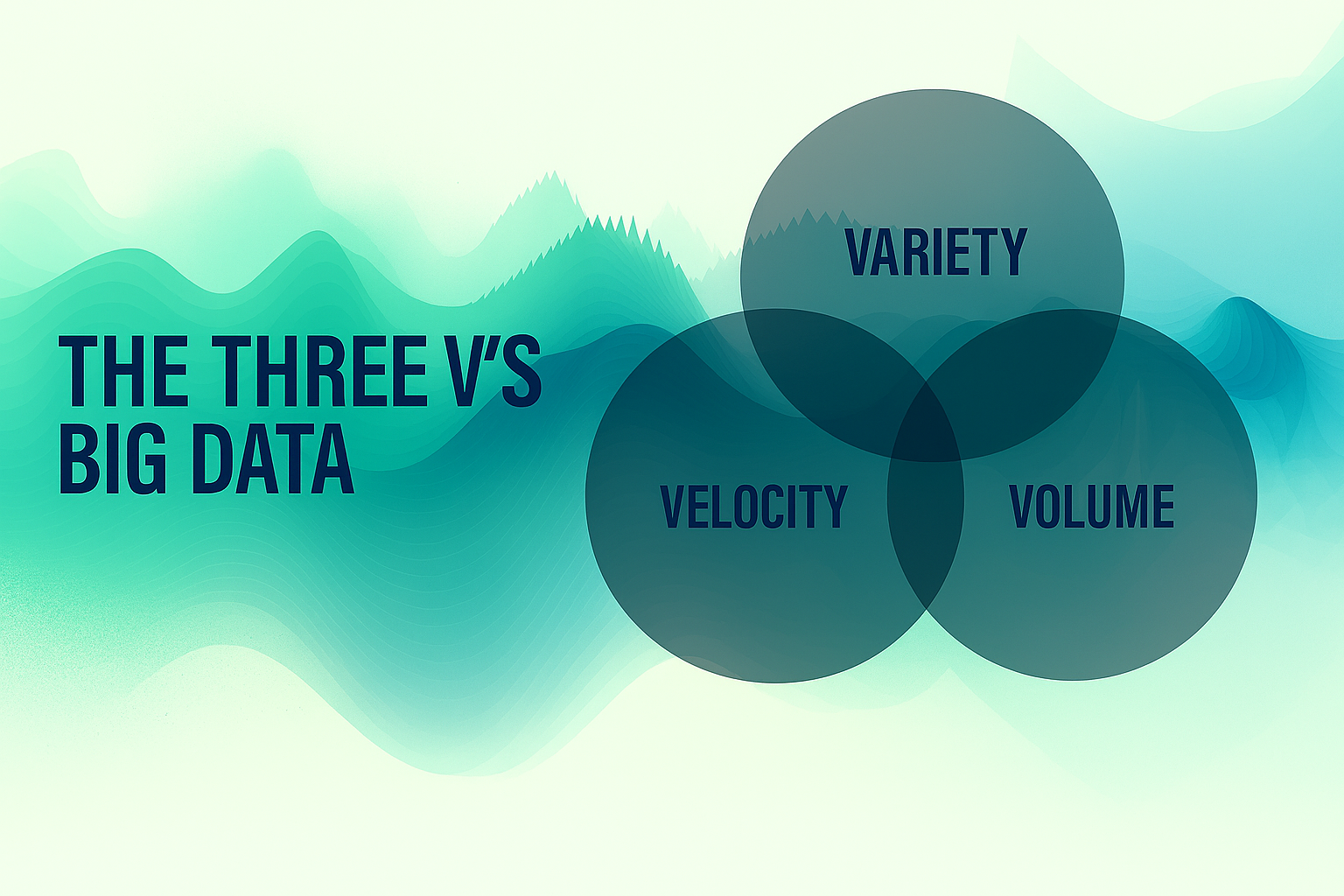
According to Gartner, Big Data is characterized by three factors: volume, velocity, and variety. In other words, we’re talking about large amounts of data, arriving at high speed and coming from diverse sources. This is the perfect scenario for AI because the more quality data, the more intelligence it generates.
AI and Big Data: an inseparable relationship
AI and Big Data are like two gears working together. AI needs data to learn, improve, and make more accurate decisions. On the other hand, we can only extract valuable insights from data with the help of AI.
Traditional analysis methods only find patterns the analyst already knows and is looking for. AI goes further: it discovers invisible correlations, hidden opportunities, and trends no one imagined. That’s what makes this technology so powerful.
The 3 V’s of Big Data explained simply
For your company to truly be AI-driven, data must have three key characteristics:
Variety
Data no longer comes only in spreadsheets. Today, it appears in videos, texts, PDFs, images, graphics, and much more. Sources are also diverse: social media, wearable devices, apps, IoT sensors. This diversity is essential to enrich AI models.
Velocity
Velocity refers to how fast data is generated and processed. Some arrive in real time, others in batches. The biggest challenge is dealing with streaming data—a continuous and accelerated flow that requires robust technologies for instant capture and analysis.
Volume
We live in a world where 2.5 quintillion bytes of data are created every day. Companies store terabytes or even petabytes of information. This massive volume is the foundation for AI strategies that truly make a difference.
How does this impact your business?
Adopting AI isn’t just adding a tool to your tech stack. It’s a strategic shift that redefines processes, culture, and even business models. Companies that master Big Data and AI can:
Predict trends with predictive analytics.
Personalize customer experiences at scale.
Automate decisions based on reliable data.
Reduce costs and increase operational efficiency.
Big Data is the foundation of the digital revolution
We are living in an era where data is the new oil—but unlike oil, it never runs out. On the contrary, it grows exponentially. AI is the machine that transforms this raw resource into actionable intelligence. Together, AI and Big Data are shaping the future of business.
If your company hasn’t started this journey yet, the time is now. Invest in data-driven strategies, build a robust infrastructure, and get ready to reap the rewards of this revolution.
Tag: IA
-
Big Data: The Fuel Driving Artificial Intelligence in Business
-

How Artificial Intelligence Is Revolutionizing Marketing and Sales
Artificial Intelligence (AI) has moved from being a futuristic promise to becoming one of the most important pillars of digital transformation. Companies operating in Marketing and Sales are discovering that AI is not just an automation tool but a strategic engine capable of generating insights, personalizing experiences, and increasing operational efficiency. In this article, we will explore how AI is impacting these areas, with practical examples, trends, and recommendations for those who want to stay competitive.
1. Personalization at Scale: The New Standard
In the past, personalizing campaigns was a costly and time-consuming challenge. Today, with AI, this has become not only possible but essential. Advanced algorithms analyze large volumes of data to identify behavioral patterns, preferences, and purchase history.Imagine an e-commerce platform recommending products in real time based on user behavior. Or an email marketing campaign that adapts tone and offers for each customer. This personalization increases conversion rates and improves the consumer experience.
Generative AI tools go further: they create texts, images, and even videos tailored to different segments, allowing brands to speak directly to each audience.
2. Intelligent Automation: Efficiency and Scalability
Chatbots and virtual assistants are clear examples of how AI is transforming customer service. They not only answer simple questions but also qualify leads, recommend products, and follow the entire sales funnel.Additionally, CRM systems integrated with AI help sales teams prioritize opportunities with a higher probability of closing. This automation reduces costs, increases productivity, and frees professionals for more strategic tasks such as negotiation and relationship building.
3. Sales Forecasting and Predictive Analytics
Making data-driven decisions is a competitive advantage. Machine Learning models allow companies to predict trends, identify opportunities, and even anticipate buying behaviors.For example, businesses can adjust prices dynamically based on predicted demand or optimize inventory to avoid stockouts. This ability to anticipate transforms commercial management and reduces risks.
4. Generative AI and Prompt Engineering: Tailored Content
Creating relevant content is a constant challenge for marketing teams. With generative AI, this process becomes faster and more efficient.Using Prompt Engineering techniques, it is possible to guide AI to produce creative texts, social media posts, video scripts, and even advertisements. This saves time and ensures consistency in brand communication.
5. Ethics, Transparency, and Explainable AI (XAI)
With the advancement of AI, responsibility also grows. Explainable AI (XAI) ensures that models are transparent and fair, avoiding biases and strengthening consumer trust.Companies that adopt ethical practices not only protect their reputation but also build stronger relationships with their customers. In an increasingly data-driven world, trust is a valuable asset.
6. Future Trends
The future of AI in Marketing and Sales is promising. Some trends already emerging:
– Multimodal AI: integration of text, image, audio, and video for richer experiences.
– Autonomous Agents: systems that make decisions without human intervention.
– Integration with IoT: connected devices generating data for even more personalized strategies.
In the next five years, we will see a convergence between AI, automation, and predictive analytics, creating intelligent ecosystems that transform how companies interact with customers.
The Future Has Already Begun
Integrating AI into Marketing and Sales is no longer optional—it is a strategic necessity. Those who invest now will be ahead, offering unique experiences and achieving superior results. Those who stand still risk losing ground to more innovative competitors.
The future is now. Are you ready to take the next step?