Today, it’s no exaggeration to say that the most successful companies have something in common: they use Artificial Intelligence (AI) and data as the foundation for growth. This combination isn’t a trend—it’s reality. And those who haven’t joined the game are falling behind.
Why is this happening? Because data is the fuel for AI. Without data, there is no artificial intelligence. And without AI, it’s nearly impossible to extract real value from data. If your company works with data science, analytics, machine learning, or any data-driven operation, the goal is clear: turn information into results.
What is Big Data and why is it so important?
Big Data is much more than a buzzword. It represents massive and varied sets of information that grow every day. Think about everything you do online: social media, Google searches, purchases, interactions with virtual assistants like Alexa or Siri. All of this generates data—and it never stops increasing.
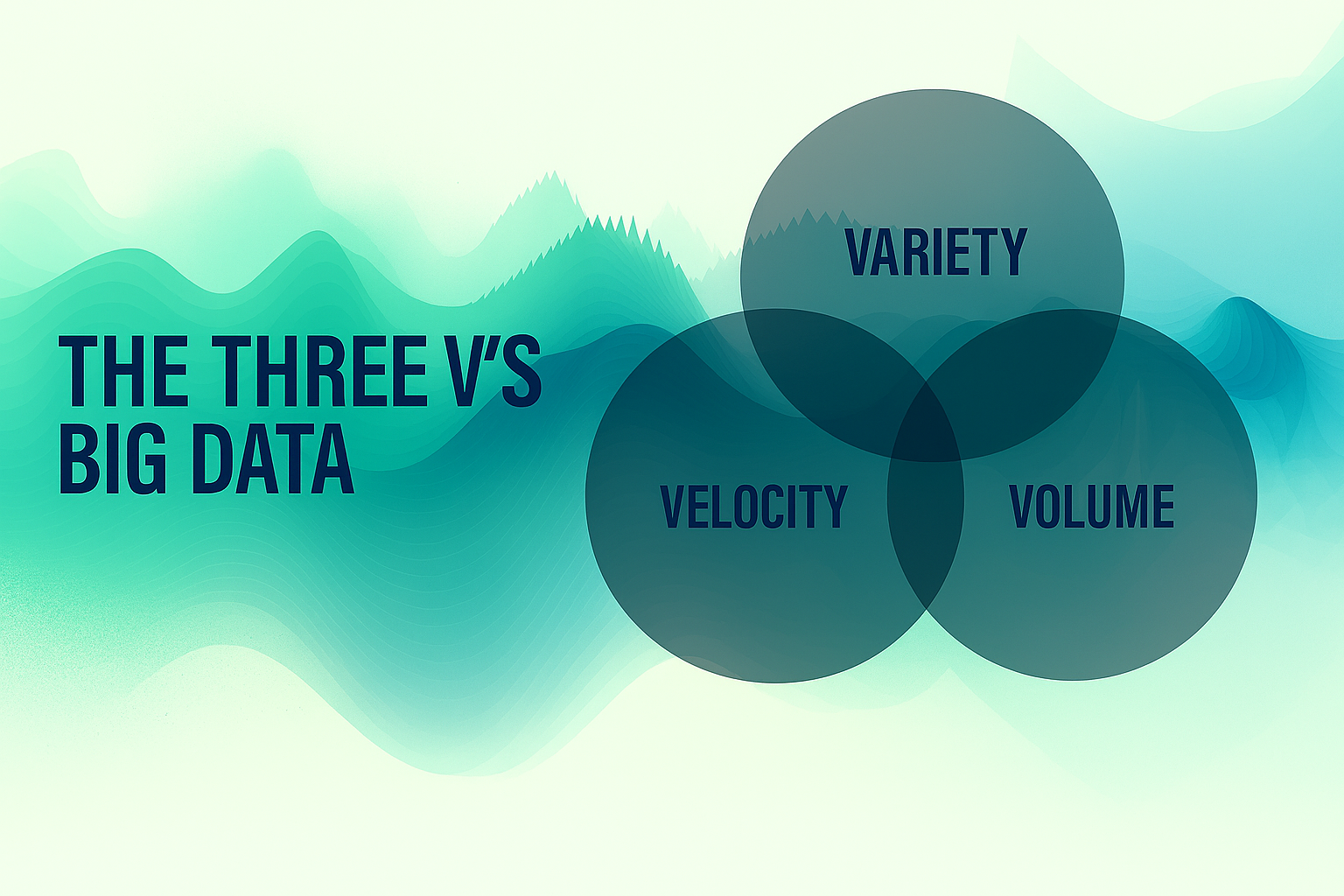
According to Gartner, Big Data is characterized by three factors: volume, velocity, and variety. In other words, we’re talking about large amounts of data, arriving at high speed and coming from diverse sources. This is the perfect scenario for AI because the more quality data, the more intelligence it generates.
AI and Big Data: an inseparable relationship
AI and Big Data are like two gears working together. AI needs data to learn, improve, and make more accurate decisions. On the other hand, we can only extract valuable insights from data with the help of AI.
Traditional analysis methods only find patterns the analyst already knows and is looking for. AI goes further: it discovers invisible correlations, hidden opportunities, and trends no one imagined. That’s what makes this technology so powerful.
The 3 V’s of Big Data explained simply
For your company to truly be AI-driven, data must have three key characteristics:
Variety
Data no longer comes only in spreadsheets. Today, it appears in videos, texts, PDFs, images, graphics, and much more. Sources are also diverse: social media, wearable devices, apps, IoT sensors. This diversity is essential to enrich AI models.
Velocity
Velocity refers to how fast data is generated and processed. Some arrive in real time, others in batches. The biggest challenge is dealing with streaming data—a continuous and accelerated flow that requires robust technologies for instant capture and analysis.
Volume
We live in a world where 2.5 quintillion bytes of data are created every day. Companies store terabytes or even petabytes of information. This massive volume is the foundation for AI strategies that truly make a difference.
How does this impact your business?
Adopting AI isn’t just adding a tool to your tech stack. It’s a strategic shift that redefines processes, culture, and even business models. Companies that master Big Data and AI can:
Predict trends with predictive analytics.
Personalize customer experiences at scale.
Automate decisions based on reliable data.
Reduce costs and increase operational efficiency.
Big Data is the foundation of the digital revolution
We are living in an era where data is the new oil—but unlike oil, it never runs out. On the contrary, it grows exponentially. AI is the machine that transforms this raw resource into actionable intelligence. Together, AI and Big Data are shaping the future of business.
If your company hasn’t started this journey yet, the time is now. Invest in data-driven strategies, build a robust infrastructure, and get ready to reap the rewards of this revolution.
Category: Artificial Inteligence
-
Big Data: The Fuel Driving Artificial Intelligence in Business
-

The Importance of AI in a Data-Driven World
Business success today is no accident. It’s directly tied to the ability to use data intelligently. That’s why so many organizations are investing heavily in Artificial Intelligence (AI) and data-driven solutions. Whether it’s AI, data science, advanced analytics, or machine learning, the goal is clear: turn data into revenue and efficiency.
AI is no longer optional. In today’s data-driven world, it’s a requirement for any company that wants to compete—big or small.
“Data is the new oil, and AI is the technology that unlocks its true value”.
Companies are sitting on a goldmine: data that, when properly leveraged, drives growth. The value of information has never been higher, and transforming into a data-driven business, powered by AI, can significantly boost revenue and valuation. More than that, it opens the door to new monetization opportunities.
What is data monetization?
It’s using proprietary data to create new revenue streams. This can mean increasing sales, reducing costs, or even generating indirect benefits like strategic partnerships. In some cases, data becomes so valuable that it turns into a service for third parties. Facebook and Google pioneered this: they built free platforms to generate massive data assets and monetize them globally.Data-driven business: a company that moves from experience-based decisions to decisions grounded in concrete data.
The gap between data-driven companies and those that aren’t has never been wider. Organizations with strong analytical capabilities are twice as likely to be at the top of their industry. Those that haven’t made the transition are falling behind.
Here’s the warning: if you don’t start now, you may never catch up.
There are seven critical reasons to start your AI strategy immediately:
- Organizational learning time
- System development time
- Integration time
- Human adaptation to AI
- Governance for AI applications
- Talent development
- Rapid scalability
Each of these steps takes time. AI systems need to be tailored to your business and knowledge domain. If they’re too generic, they add little value. Then comes integration into processes and IT architecture—something that doesn’t happen overnight.
Even with autonomous systems, most AI solutions focus on augmented intelligence, meaning AI working alongside humans to improve learning, decision-making, and experience. This means your team must be prepared. Technology will redefine roles and require retraining.
AI also demands strong governance. Monitoring intelligent systems is complex and requires dedication. And it doesn’t stop there: you’ll need to reorganize talent, create new processes, and adapt your culture. AI specialists are in high demand, making hiring a challenge. Existing knowledge often needs to be reframed to fit AI frameworks.
When AI is successfully implemented, scaling happens fast. Early adopters gain market share and reduce costs, while late movers fall behind.
The common thread? Time. Every step takes time, and if you didn’t start yesterday, you risk losing tomorrow. But starting now secures a competitive edge. Yes, early movers face steeper learning curves, but they also have more time to evolve—and that’s a huge advantage.
AI isn’t a trend. It’s the foundation for competing in a data-driven world. In complex, consultative B2B sales, it’s the strategic partner that turns data into intelligence, intelligence into action, and action into results. Those who start early don’t just keep up—they lead.
-
AI as the engine of consultative B2B sales
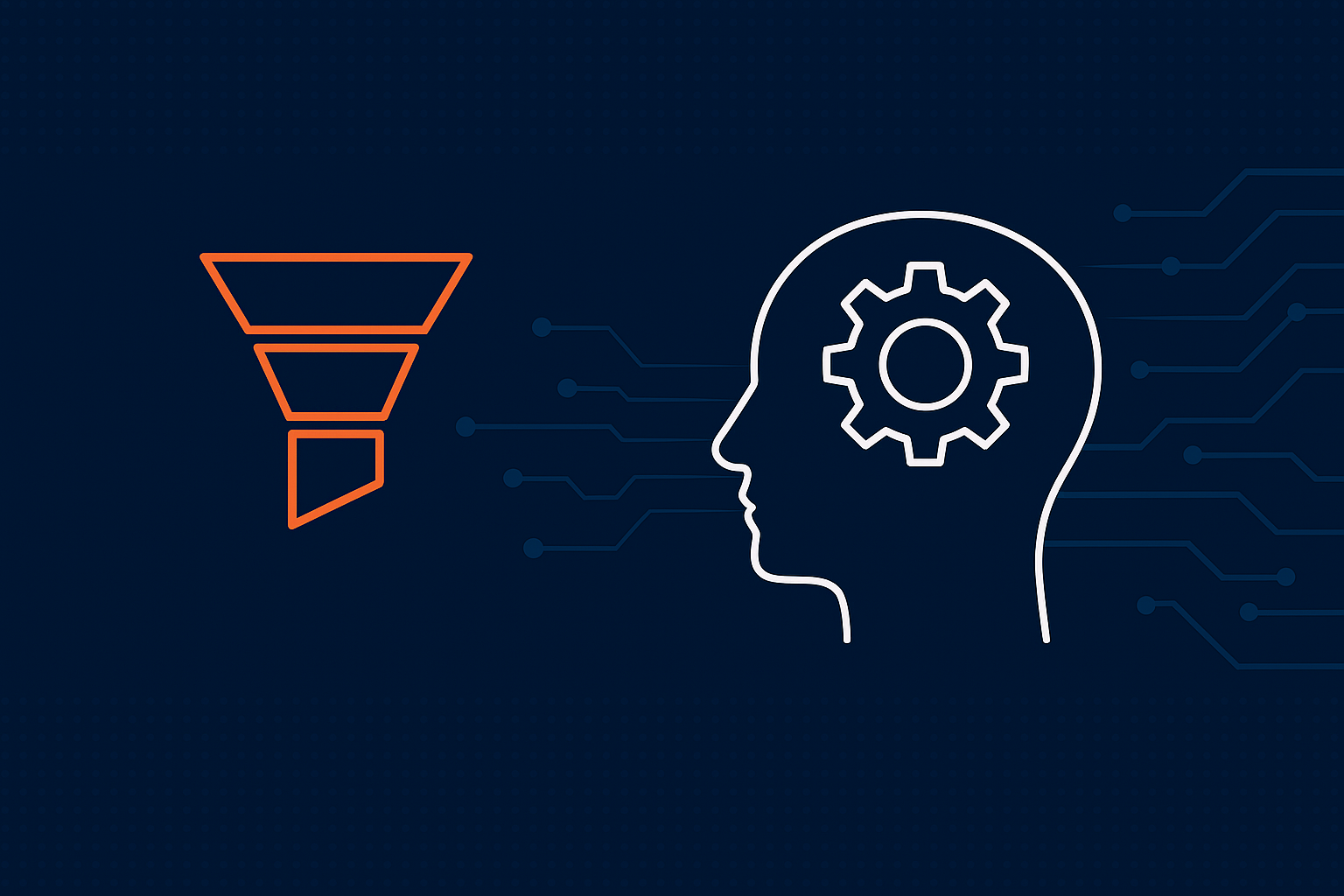
In B2B, selling is a disciplined advisory journey that turns a value hypothesis into measurable outcomes. Buying committees are complex, decision cycles are long, and differentiation hinges on diagnosis quality rather than discounting. Artificial Intelligence (AI) has become the engine of this journey because it converts fragmented data into operational clarity: it reveals intent, surfaces timing, and backs proposals with evidence.
Foundations: how AI works and why it matters
AI is a set of techniques that emulate human cognition — learning, reasoning, and deciding — based on data. Machine learning (ML) powers AI: models ingest history, uncover patterns, and update predictions iteratively without hard‑coded rules. Data mining is the substrate: integrating CRM, marketing automation, product usage, finance, and support to build a 360º account view. In B2B, better data integrity translates directly into better recommendations and higher sales efficiency.
ML techniques applied to the consultative funnel
Supervised learning uses labeled outcomes (won/lost, qualified/not qualified) to predict results — lead scoring, revenue forecasting, SKU purchase propensity, churn detection. Unsupervised learning discovers latent structure — clustering for behavioral segments and association for cross‑sell relationships. Reinforcement learning optimizes dynamic policies — pricing, discounting, and contact sequences across channels.
Applications across the funnel
Prospecting: AI ranks accounts similar to your ICP and leverages external signals such as hiring trends and public project mentions to raise response rates. Qualification: propensity models recommend which leads to advance; NLP on discovery notes flags gaps and suggests consultative questions. Discovery & proposal: AI quantifies impact through ROI simulations and adoption roadmaps tailored to business objectives. Negotiation: algorithms recommend pricing bands and commercial terms to protect margin, while stakeholder analysis maps influencers and detractors for message fit. Post‑sale: risk models anticipate churn and guide retention actions; cross‑sell and up‑sell emerge from success patterns in the best accounts.
Minimal data architecture and tooling stack
A practical impact requires a simple, reliable architecture: CRM as the commercial source of truth; marketing automation to capture engagement; a warehouse/lake to integrate sources; an analytics layer (BI/notebooks); and ML services to train and serve models. Governance defines table owners, refresh SLAs, and a shared metric dictionary (MQL, SQL, opportunity, pipeline). Tools with native connectors and low‑code features accelerate time‑to‑value; custom models demand reproducible pipelines and drift monitoring.
Metrics, experimentation, and ROI
Build a metric tree that ties inputs to outcomes: ICP coverage, response rate by segment, qualification effectiveness, cycle velocity, win rate, margin per deal, and revenue expansion (NDR). Run controlled experiments (A/B) on cadences, messages, and offers, measuring lift versus control and documenting learnings so they become repeatable playbooks. ROI stems from conversion, cycle acceleration, and margin optimization. Quantify impact in dollars to secure executive sponsorship.
Risks, ethics, and governance
B2B AI touches people and sensitive data. Establish principles — transparency, fairness, security, consent — and train teams to treat recommendations as decision support, not orders. Audit models periodically to avoid bias and performance degradation as markets shift.
AI does not replace consultative selling; it amplifies it. With organized data, fit‑for‑purpose models, and disciplined experimentation, commercial teams gain precision, deeper diagnosis, and confident recommendations. Starting now creates a hard‑to‑copy advantage: a learning loop that improves with every meeting, proposal, and negotiation.